This post may contain affiliate links
Table of Contents
If you want to reach your goals, stop setting them once a year!
Have you ever set a big goal in January, felt excited for a few weeks, and then completely forgotten about it by spring?
You’re not alone.
For years, we’ve been taught that success comes from setting annual goals. Every December and January, we’re encouraged to create vision boards, map out twelve-month plans, and predict exactly what we’ll accomplish over the next 365 days.
The problem?
Life doesn’t work that way. Businesses don’t work that way.
And if the last several years have taught us anything, it’s that things can change incredibly fast.
When I stopped obsessing over annual planning and started using a 12-week planning system, my business grew faster than it ever had before. In fact, during one of the most uncertain periods in recent history, I increased my income by nearly five times.
It wasn’t because I worked harder.
It wasn’t because I discovered some magical marketing strategy.
It was because I finally learned how to focus.
Listen to the Episode
Podcast: Play in new window | Download
Why Annual Goals Often Fail
Traditional yearly planning sounds great on paper. You sit down in January and decide what you want to accomplish by December. You map out projects, create timelines, and build a detailed strategy.
Then reality shows up
A new opportunity appears, or a platform changes its algorithm.
Your audience shifts (or disappears completely!)
A family emergency happens, or let’s say… a global pandemic turns everything upside down?
Suddenly, the carefully crafted yearly plan you spent hours (maybe days?) creating no longer makes sense.
If you’ve ever worked in a corporate environment, you’ve probably experienced this firsthand. Teams spend weeks building annual plans only to spend the rest of the year revising them.
The longer the planning horizon, the more likely it is that circumstances will change before you reach the finish line.
That doesn’t mean having a long-term vision is bad, it just means annual execution plans often become outdated before they’re ever completed.
The Problem Isn’t Your Goals
Most people assume they fail because they aren’t disciplined enough (that’s usually not true)
The real issue is that the timeline is too long. When you have an entire year to accomplish something, there’s very little urgency.
Missing a week doesn’t seem like a big deal and missing a month doesn’t feel catastrophic.
Before you know it, six months have passed and you’re wondering where the year went.
The challenge isn’t setting the goals, it’s maintaining focus long enough to execute the plan to achieve them.
Cue the 12 Week Year
The 12 Week Year (on Amazon) created by Brian Moran, takes a completely different approach.
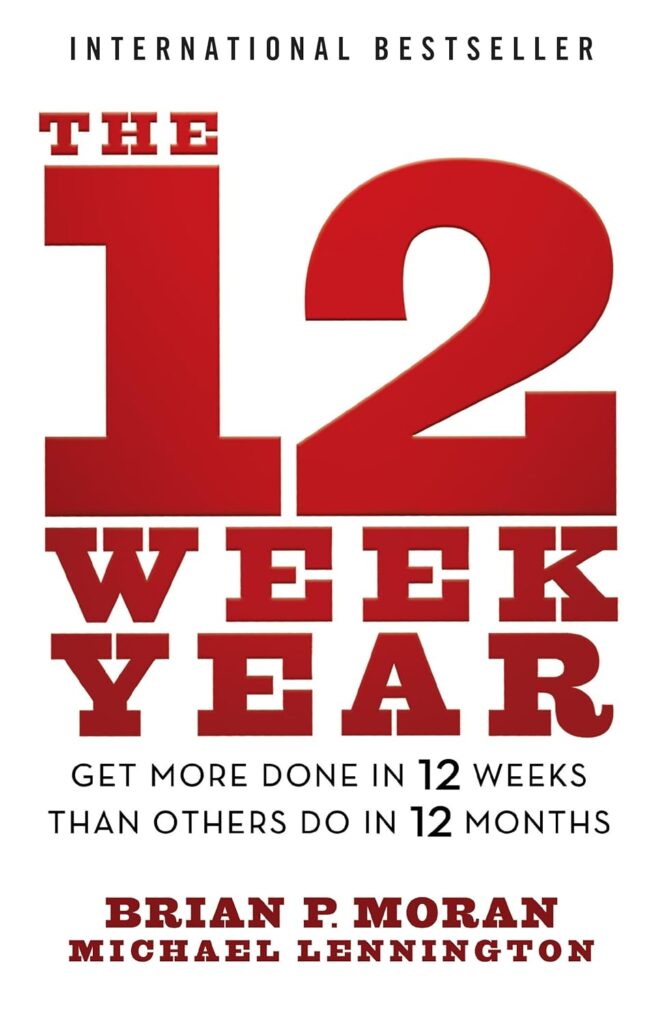
Instead of treating a year as your primary planning period, you treat every 12 weeks as its own “year.”
You still have long-term goals.
You still have a vision.
But your execution window becomes dramatically shorter.
Rather than asking:
“How will I achieve this by next December?”
You ask:
“What can I accomplish in the next 12 weeks that moves me significantly closer to my long-term vision?”
It’s a simple shift, but it changes everything.
Why 12 Weeks Works So Well
Twelve weeks sits in a sweet spot.
It’s short enough to maintain urgency, but it’s long enough to create meaningful results.
It’s enough time to:
- launch a new offer.
- Build a referral network.
- Grow your email list.
- Improve your systems.
- Create content.
- Generate new leads.
- Establish new habits.
Most importantly, it’s short enough that you can see whether your strategy is working before wasting an entire year.
If something isn’t producing results, you don’t wait until December to adjust, you can pivot after a few weeks.
Research on goal achievement suggests that shorter-term goal structures can increase engagement and performance because deadlines feel more immediate and actionable. Studies examining goal length have found that goal duration influences how effectively people pursue objectives and maintain momentum.
The Hidden Power of Urgency
Think about how differently you behave when a project is due next year versus next month.
When the deadline feels far away, procrastination becomes easy.
When the deadline is close, focus sharpens.
That’s exactly why shorter execution cycles work.
A 12-week cycle creates natural urgency without creating panic.
You don’t have time to:
- endlessly research.
- time to chase every shiny object.
- spend six months redesigning your website instead of selling your services.
You focus on what matters now and that focus creates momentum.
Start with the Long-Term Vision
One of the biggest misconceptions about the 12-Week Year is that it ignores long-term planning.
It doesn’t.
In fact, long-term vision becomes even more important.
It recommends creating:
- A 5-year vision
- A 3-year vision
- A 1-year vision
The difference is that you don’t spend all your energy trying to execute a year’s worth of goals at once.
Instead, you work backward.
Ask yourself:
“If I want to be here in five years, what needs to happen this year?”
Then ask:
“If I want to achieve that this year, what needs to happen in the next 12 weeks?”
Suddenly your goals become much clearer.
Focus on One or Two Goals
This is where many entrepreneurs struggle.
We want everything.
- More clients.
- More followers.
- More email subscribers.
- A new website.
- A new offer.
- A podcast.
- A membership.
- A course.
- A book.
- …maybe a YouTube channel while we’re at it?
The problem is that every priority competes with every other priority. When everything matters, nothing gets enough attention.
One of the biggest reasons the 12 Week Year works is because it forces prioritization.
Choose one or two goals, ask yourself: “What would make the biggest difference in my business over the next 12 weeks?”
That could be:
- client acquisition
- growing an email list
- building strategic partnerships
The goal should be something that genuinely moves the needle for YOUR business.
Use the 80/20 Rule
Once you’ve selected your goals, don’t create a giant to-do list.
Instead, identify the few activities that drive the majority of results.
This is where the 80/20 Principle comes in. There may be 100 things you could do but only a handful actually make a difference.
If your goal is getting more clients, the highest-impact activities might be:
- Networking
- Referral outreach
- Sales conversations
- Following up
- Content that builds authority
Everything else becomes secondary.
The question moves from “What more can I do?” to “What specific activities produce the most results?”
Turn Goals Into Weekly Actions
A goal without action is just wishful thinking.
Once you’ve chosen your goals, break them down into weekly commitments.
For example, let’s say your goal is to add 10 new clients in the next 12 weeks.
Your Weekly Action tasks:
- Reach out to 20 potential referral partners
- Attend one networking event
- Publish two authority-building articles
- Follow up with all warm leads
- Schedule five sales conversations
Now you know exactly what success looks like each week.
No guessing.
No wondering what to work on.
No spending Monday morning deciding what matters.
You already know.
Track Everything
One of the biggest mistakes entrepreneurs make is relying on memory.
They think they’re making progress.
They think they’re being consistent.
They think they’re taking action.
Then they look at the numbers and realize they haven’t been nearly as consistent as they thought.
Tracking eliminates assumptions.
I personally use simple spreadsheets.
Nothing fancy.
Every day I check off completed activities.
Every week I review performance.
Every month I assess results.
This creates a feedback loop.
You quickly learn:
- What’s working
- What’s not working
- Where you’re consistent
- Where you’re avoiding action
Research consistently shows that monitoring progress improves goal achievement because it creates awareness and opportunities for course correction.
Accountability Changes Everything
This may be the most important part of the entire process.
Accountability.
Because let’s be honest.
Most of us know what we should be doing.
The challenge isn’t knowledge.
The challenge is execution.
When nobody is paying attention, it’s easy to skip the uncomfortable tasks.
It’s easy to postpone outreach.
It’s easy to avoid sales conversations.
It’s easy to convince yourself you’ll do it next week.
Accountability removes that escape route.
During the period when my business experienced its biggest growth, I had regular accountability meetings.
Every week, I had to answer a simple question:
“Did you do what you said you were going to do?”
Not:
“Did you have good intentions?”
Not:
“Did you stay busy?”
Not:
“Did you think about it?”
Did you do it?
That simple level of accountability changed everything.
My 5X Growth Experience
When I implemented this system, I wasn’t chasing perfection.
I wasn’t trying to build the perfect website.
I wasn’t creating the perfect funnel.
I wasn’t obsessing over logos, colors, or branding.
I focused on the activities that generated results.
Every week.
Every month.
Every 12-week cycle.
The consistency compounded.
And the business grew.
Not because of a revolutionary strategy.
Because of focused execution.
That’s the real lesson.
Most entrepreneurs don’t need more information.
They need a better system for acting on the information they already have.
The Bottom Line
Annual goals aren’t necessarily bad.
They’re just too far away to drive consistent execution.
Keep the long-term vision.
Keep the big dreams.
Keep the ambitious goals.
But execute in 12-week cycles.
Focus on one or two priorities.
Create weekly action plans.
Track your progress.
Stay accountable.
Then repeat.
Four focused 12-week cycles will often accomplish more than one unfocused year.
If you’re tired of setting goals and wondering why they never seem to happen, the 12 Week Year might be the framework you’ve been missing.
Frequently Asked Questions
What is the 12 Week Year strategy to reach your goals?
The 12 Week Year is a goal-setting and execution framework developed by Brian Moran. Instead of treating a calendar year as your primary planning cycle, you work in focused 12-week periods designed to increase urgency, focus, and accountability.
Is the 12 Week Year better than annual planning to reach your goals?
For execution, many people find it more effective because the shorter timeframe makes it easier to stay focused and adjust quickly when circumstances change. Annual planning can still be useful for long-term vision and direction.
How many goals should I have in a 12-week plan?
Most people should focus on one or two major goals. Trying to pursue too many priorities at once often leads to diluted effort and slower progress.
What kinds of goals work best?
Goals that directly impact business growth tend to work well. Examples include increasing revenue, growing your email list, signing new clients, launching an offer, or building strategic partnerships.
How often should I review my progress?
Weekly reviews are ideal. Weekly check-ins help you identify obstacles, celebrate wins, and make adjustments before small problems become major setbacks.
Do I need an accountability partner?
Technically, no. Practically, accountability dramatically improves consistency. Whether it’s a coach, mastermind group, business partner, or trusted friend, having someone who expects progress can significantly increase follow-through.
Where can I learn more about the 12 Week Year?
Brian Moran’s book, The 12 Week Year, provides a detailed breakdown of the system and includes templates, examples, and implementation strategies. You can find it here:
Episode Transcript
I’m Laurie Mallon, and this is the Profitable Health Coach Podcast, the show where we’re all about creating a sustainable, enjoyable, and profitable online coaching business that gives you the freedom and flexibility that you want. We’ll hear about strategies, systems, and solutions from experts and fellow coaches who’ve created the business of their dreams, providing amazing transformations, and connecting with clients across the globe. You’ll learn how to get started without the technical overwhelm.
Join me on this journey to become a profitable health coach. In this episode, we will be talking about how to use a 12-week plan to set and reach your goals. So, too many of us have been taught to focus on yearly goals, but there is a strategy that I have found to be so much more effective.
And when I put it into practice in my business, I ended up increasing my income by five times. I think 12-week planning is perfect for everyone, but it is going to be particularly effective for you if you can check any of these boxes, right? S
o if you’ve been running your own business for a while, but you aren’t really sure how to set goals that you’re going to actually achieve, or you’ve been following all the big names in online business, listening to all the podcasts, reading all the blogs, and you’re overwhelmed with all of the different strategies to grow your business,
or you aren’t really sure which tasks you need to work on or for how long until you should switch to something else because it’s not working, or if you have worked on getting clients or building programs for weeks, months, maybe years, but you have little progress to show for it, you know that there are a lot of things that you should be doing, but you find yourself constantly pulled in different directions, distracted by shiny objects.
Or if you’ve reached goals, but you aren’t really sure how it happened, or how you got there, or how to keep growing, this planning strategy is perfect for you.
Now, if you’re like me and you worked a corporate job before you had your own business, you probably, at the beginning of every year, you would sit down and write out your plans for the year, and there would be these 12-month plans and you’d have all these different deliverables and goals that you would set,
and then you would spend so much time mapping out the goal, and then a few months or even weeks later, something would happen, priorities would change, and all of the goals that you made or all of the goals that you set would go right out the window because now you had new priorities.
So then those plans had to all be completely redone, and I’m looking at you March 2020 when all of our plans went out the window, and then you’ll find that those year-long plans were actually a huge waste of time. So as you’re running your own business, you’re going to find that certain strategies or tactics that you decide on at the beginning of the year might be outdated or completely irrelevant a few months later, and this is where we cue the 12-week year system.
Now, the 12-week year is a goal-setting strategy created by Brian Moran, and it outlines exactly how to set and achieve goals in just 12 weeks. Now, why do we focus on just 12 weeks at a time? 12 weeks is short enough that you don’t lose focus, but long enough that you can make significant progress towards your goals. It’s enough time to see if the strategy that you’re using is actually working for you, and if not, there’s enough time to pivot and adjust your plan.
It’s really the perfect amount of time for working on a specific goal. This is the strategy that I used to 5x my business during the pandemic, and it’s a process that I use with my own one-on-one clients. In the 12-week year, we create these long-term goals, five years out, three years out, one year out, and then we break it down into the first 12-week plan.
We’d call it a 12-week year. We start with that first. Switching to these 12-week plans gives you the flexibility that you need to achieve your goals, setting them one goal at a time and working on just one thing at a time, focusing on that, and nothing else.
Now, a 12-week plan also helps you gain momentum. You don’t want to wait until the end of the year to see your results, right? No, you want to see results as quickly as possible, and you want to know that what you’re doing is working, right?
Because success breeds motivation, motivation breeds action, and action breeds more success. So seeing actual results in your business keeps you motivated to keep going, keep showing up, keep taking action and growing your business.
When I was creating my first 12-week plan, I started with my long-term vision of five years, and then I worked it back to three years and then one year. And I sat down and really thought about what I needed to do now to make that one-year vision a reality. Now, I set no more than one or two goals at a time, and based on where you are in your business, that goal might look like getting more one-on-one clients, growing an email list, or really focusing on growing your network and referral partner list.
Having more than two goals might be tempting when you’re first starting out, but it can make it hard to stay focused. So your goals should be your top priorities, the things that are really going to move the needle in your business. What’s also great about a 12-week plan is that it lets you create focused action plans, right? Because a goal without a plan is just a dream.
After we set the goals for the 12 weeks, we break it down into three to five action tasks that are going to have the most impact in getting us closer to our goal. Now, there are probably going to be a hundred different things you could do that could help you reach your goal, but you want to use the 80-20 rule here, right?
Like what are the few things that you can do that have the most impact? You’re going to break these tasks down into weekly action plans so that you know each week what you’re going to be doing week in and week out to get closer to your goal. The next thing you’ll do with your 12-week plan is you’re going to track your progress.
So I use a very specific 12-week year spreadsheet, and what I do is I map out my weekly action plan and I check each task off that I need to do on the plan as I do it. And I keep a record of this so that each week I can see how closely I stuck to my plan, and I can see if these tasks are actually effective in generating the results that I’m looking for. The last part of the 12-week year action planning system that’s really important is the accountability.
Now with the 12-week year, we take ownership of our actions and we are 100% responsible for doing what we say we’re going to do. The American Society of Training and Development did a study and they found that people are 65% more likely to meet a goal after committing it to another person, right?
So that’s just telling somebody, hey, I’m working on this goal. But their chances of success increased to 95% when they build in ongoing meetings with their accountability partners to check in on their progress.
Yes, you heard me right. I said 95%. So they’re 95% more likely to reach their goal after setting it, telling somebody else, and then showing up week after week to report on their progress.
So committing to a weekly accountability meeting and reporting on the progress of your action plan are critical parts of successfully using the 12-week year planning system to grow your business.
Now, I know I wouldn’t have been able to grow my business as quickly as I did without having weekly check-ins with my accountability partner, Kathy, who has been on the podcast before. Kathy and I started meeting in March of 2020, coincidence.
I don’t think so. But we both seen significant growth in our businesses and I’m going to link to her episode in the notes. Kathy, during the pandemic, published three plant-based eating cookbooks.
And she also launched a plant-based lifestyle coaching program that has catapulted her business from basically, she started out as a food blogger, and now she is a six-figure plant-based lifestyle coach. And this all happened during the pandemic. So I’m going to link this in the show notes.
And if you want to learn more about the 12-week year strategy that I’m talking about, I’m going to put a link in the show notes as well for the book by Brian Moran. And the 12-week year, this planning system has completely changed my business and that’s what I want for you. So I hope this helps you as you are starting your business.
Thanks for listening. And if you liked this episode, go ahead and leave us a review on iTunes or wherever you listen to podcasts and be sure to subscribe so you’ll be notified when the next episode is live. Check out our show notes for this episode where you can find any of the links and resources that were mentioned during the show.
Thanks for listening and we’ll catch you in the next episode.